Original english article
I remember the first time I snuck into my adoptive parents’ bedroom to look at my adoption file. I was around ten years old, and I was so curious about the file itself. Nothing of importance was in there: I was just an abandoned child, 김오묘. My adoptive parents never hid the file from me, but for some reason I would always do it by myself, sneakily, privately. I would take it out of the cabinet and slowly look through the pages, running my fingers along the Korean characters, looking at the baby photos, trying to find myself.
***
On July 19th, 2025, the responsibility of the adoption files of some 260,000 adoptees transferred from private adoption agencies to the Korean government, namely the National Center for the Rights of the Child (NCRC). It was generally hailed as a good decision, the right move that should have happened a long time ago. Unfortunately, the execution of this decision has been problematic at almost every step of the way. Adoption Services at the NCRC has been criticized for not including the voices of adoptees and in late April, the NCRC announced that the adoption files will be moved to a temporary storage center in Goyang.
Hosu Kim, professor at The City University of New York, writes about archival violence in intercountry adoption that controls information about individual birth records. She writes, the ways in which birth information is “controlled, neglected, or arbitrarily stored are not merely bureaucratic hassles; they impact individuals at a fundamental existential or psychological level.”
How can an archive be violent? The violence is in the gaslighting. By not only denying a basic human right of identity, but constantly making one feel wrong for asking. It’s social workers telling adoptees how stressed they are by all the requests by adoptees. It’s telling adoptees that the cooling storage center in Goyang was the “best” they could do. It tells adoptees that there is no budget for an archive while estimates of how much money international adoption generated in the 1970s and 80s conservatively range from $20 million to $40 million a year (Oh, 2015).
As a Korean adoptee, I too submitted an application for my adoption file to the NCRC. It’s a lot to fill in the form, emotionally, but also logistically. The form is confusing, you need to know what “information communication network” is, and you need to not press “save” because sometimes it deletes your information and you need to start over. It took 45 days and two unanswered emails to learn that my application was lost in the “system.” My situation is *not* unique. This is not a one-time mistake, but a systemic problem. And it’s been happening for years, but it never got better.
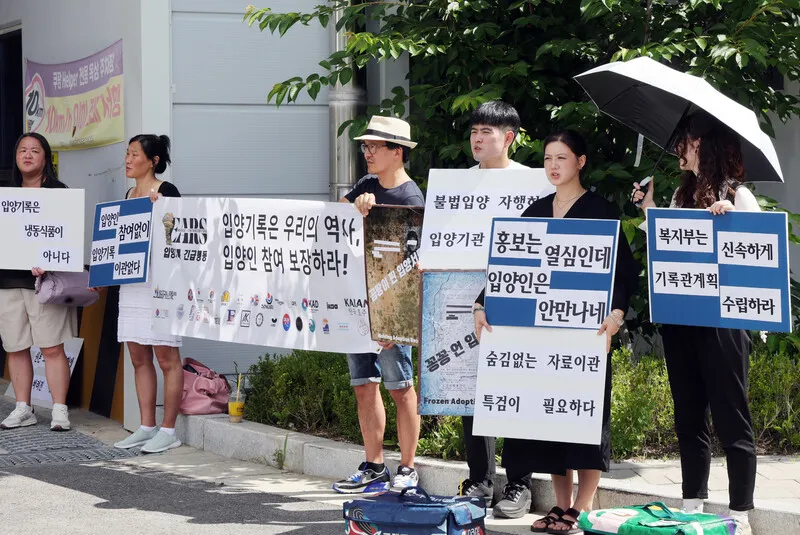
On Thursday, August 7th, the NCRC held an information briefing for intercountry adoptees. This happened due to the very public urging of EARS through press and protests, to actually talk to adoptees about what is happening. To actually open the doors for us. As is typical at these events, the president of NCRC, Chung Ick-Joong, was not present. Even though it was held in the NCRC building, and there were two sessions (one in the morning and one in the afternoon) the president was unable to stop in. Where was he? He was in his director’s office, in the building.
To quote one adoptee who posted online, this briefing was a “hot mess.”
Director of adoption division Han Myoung-ae, repeatedly evaded questions. When asked why the Ministry of Health and Welfare was asked to attend the day before the meeting, or why the Gimpo City site wasn’t chosen as a candidate for the archive, or how many additional staff members were hired for the records transfer this year, she remained silent or gave vague answers. The Q & A segment was heated, and at some point, adoptees from all over the world participated in the Zoom chat – “Shame on you!”
To be clear, this is not our legacy. Our legacy will not be a warehouse turned temporary archive in Goyang. That will be the legacy of Adoption Services at the NCRC.
Our legacy will be housed in the many acts of survival and empowerment that Korean adoptees enact every single day. It is present in the ways we learn to love and accept ourselves, in the ways we have built community. It is housed in our stories, documentaries, and activism, and will continue with the next generation.
I hope that one day our adoption files will be protected as a part of Korean history. I hope they can be housed in a proper, respectful archive that says: your existence here, in this country, is essential, honored, and permanent.